
Grade 2 and Grade 3 Whiplash Treatment in Portland, OR: How Chiropractic Care Supports Advanced Recovery
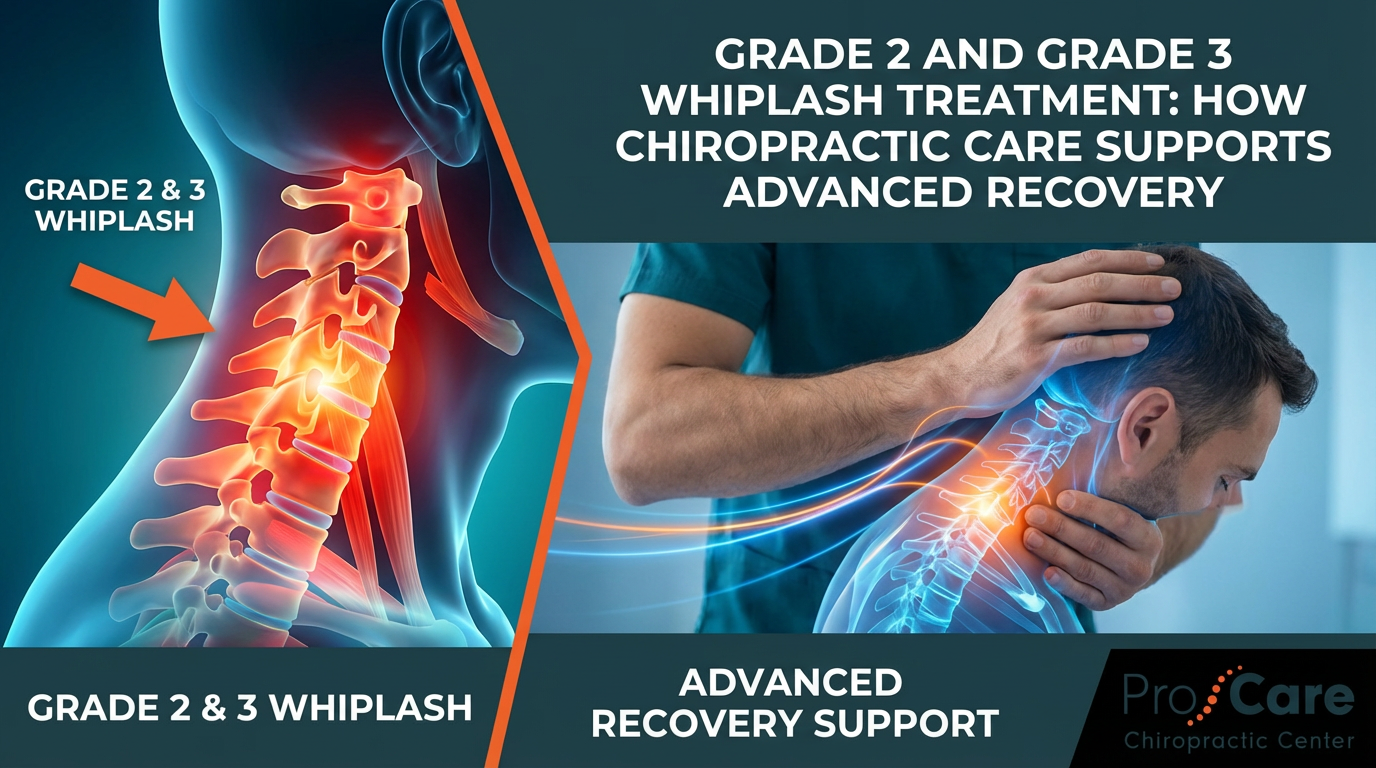
Whiplash injuries are among the most common and misunderstood consequences of motor vehicle accidents. While mild cases may resolve with conservative care, Grade 2 and Grade 3 whiplash injuries involve significantly greater structural damage and require a more comprehensive rehabilitation strategy.
Chiropractic care plays a critical role in managing moderate to severe whiplash injuries by addressing spinal misalignment, soft tissue damage, inflammation, restricted motion, and neuromuscular dysfunction. Rather than simply masking symptoms, chiropractic treatment focuses on restoring proper biomechanics and supporting the body’s natural healing mechanisms.
Recover from severe neck trauma at ProCare Chiropractic Clinic in Portland, OR. We provide specialized care for Grade 2 and Grade 3 whiplash to restore your mobility.
Understanding how chiropractic care contributes to the recovery process can help patients make informed decisions after a serious neck injury.
Understanding Grade 2 and Grade 3 Whiplash
Whiplash is typically classified using the Quebec Task Force grading system:
Grade 1
Neck pain and stiffness without significant physical findings.
Grade 2
Neck pain accompanied by musculoskeletal signs such as:
- Decreased range of motion
- Muscle spasms
- Tenderness
- Partial ligament or soft tissue injury
Grade 3
Neck pain with neurological involvement, including:
- Numbness or tingling
- Weakness
- Altered reflexes
- Possible nerve compression
Grade 2 and Grade 3 injuries are more complex because they involve:
- Ligament strain or tearing
- Muscle fiber damage
- Inflammation
- Joint dysfunction
- Possible nerve irritation
In some cases, imaging does not clearly show the extent of soft tissue injury, yet patients experience significant pain and dysfunction.
Why Whiplash Is More Serious Than It Appears
Whiplash occurs due to rapid acceleration-deceleration forces, most commonly in rear-end collisions. The head is thrust backward and then forward, placing enormous strain on:
- Cervical vertebrae
- Intervertebral discs
- Facet joints
- Ligaments
- Paraspinal muscles
- Nerve roots
Even at low speeds, this sudden motion can produce microtears in soft tissues. In Grade 3 injuries, nerve structures may also be affected.
Without appropriate treatment, patients may develop:
- Chronic neck pain
- Headaches
- Reduced mobility
- Postural dysfunction
- Persistent nerve irritation
- Long-term disability
Early, structured intervention is essential to prevent chronic complications.
The Chiropractic Approach to Moderate and Severe Whiplash

Chiropractic care differs from conventional approaches that often rely primarily on rest and medication. Instead, chiropractic treatment aims to:
- Restore spinal alignment
- Reduce inflammation
- Improve joint mobility
- Rehabilitate soft tissues
- Normalize nerve communication
- Prevent scar tissue restriction
A comprehensive plan for Grade 2 and Grade 3 whiplash may include several integrated therapies.
Spinal Adjustments and Cervical Realignment
One of the central components of chiropractic care is spinal adjustment.
After whiplash, the cervical spine often develops:
- Segmental misalignment
- Facet joint restriction
- Abnormal motion patterns
Gentle, controlled adjustments help:
- Restore proper joint movement
- Reduce nerve irritation
- Improve blood flow
- Reduce muscle guarding
For Grade 2 and 3 injuries, adjustments are typically modified and progressive, ensuring safety while gradually restoring normal biomechanics.
Proper alignment decreases mechanical stress on injured tissues and supports healing.
Soft Tissue Therapy for Ligament and Muscle Damage
Grade 2 and 3 whiplash injuries frequently involve significant soft tissue trauma. Muscles, tendons, and ligaments become inflamed and may develop scar tissue during the healing process.
Chiropractors often incorporate:
- Myofascial release
- Trigger point therapy
- Therapeutic stretching
- Instrument-assisted soft tissue mobilization
These techniques help:
- Break down adhesions
- Improve circulation
- Restore flexibility
- Reduce chronic stiffness
Scar tissue formation is a natural part of healing, but excessive or poorly organized scar tissue can limit range of motion and cause long-term pain. Early therapeutic intervention helps minimize these complications.
Inflammation Management and Natural Healing Support
Inflammation is both protective and potentially harmful.
In acute whiplash injuries, inflammation helps initiate healing. However, prolonged inflammation can:
- Delay recovery
- Increase pain
- Contribute to chronic conditions
Chiropractic adjustments and soft tissue therapies help modulate inflammatory responses by:
- Improving lymphatic drainage
- Enhancing circulation
- Reducing mechanical stress
- Supporting immune regulation
By improving spinal function, the nervous system can more effectively coordinate tissue repair.
Restoring Range of Motion After Whiplash
Loss of motion is a hallmark symptom of Grade 2 and Grade 3 whiplash.
Patients may struggle with:
- Turning the head
- Looking upward or downward
- Sustained posture
- Shoulder movement
A structured rehabilitation program often includes:
- Gentle mobilization
- Controlled cervical exercises
- Strengthening protocols
- Postural retraining
Movement is critical to prevent joint stiffness and muscular shortening. Chiropractors carefully progress mobility exercises based on individual tolerance and recovery stage.
Neurological Considerations in Grade 3 Whiplash
Grade 3 injuries involve neurological symptoms such as:
- Radiating arm pain
- Numbness
- Tingling
- Muscle weakness
These symptoms may indicate nerve root irritation or compression.
Chiropractic care focuses on reducing mechanical pressure and restoring proper nerve signaling. When performed appropriately, spinal adjustments can help relieve joint dysfunction that contributes to nerve irritation.
However, thorough examination and patient-specific assessment are essential before initiating treatment.
Patient Education and Active Recovery
Chiropractic care emphasizes patient participation.
Education may include:
- Proper sleeping positions
- Ergonomic modifications
- Postural awareness
- Activity modification
- Gradual return-to-work strategies
Empowered patients often experience faster recovery because they understand:
- What movements to avoid
- How to perform home exercises
- How to reduce re-injury risk
Education transforms recovery from passive care into active rehabilitation.
Nutritional Support in Whiplash Recovery
Healing requires adequate nutritional support.
Chiropractors may recommend:
- Anti-inflammatory foods
- Adequate protein intake
- Hydration strategies
- Micronutrient optimization
A well-nourished body is better equipped to repair damaged ligaments and muscle fibers.
Nutrition is not a substitute for treatment — but it enhances tissue repair and overall resilience.
Addressing the Mind-Body Connection
Whiplash injuries often occur during traumatic events. Emotional stress can:
- Increase muscle tension
- Slow healing
- Amplify pain perception
Chiropractic care recognizes the interplay between physical and emotional health. Reducing musculoskeletal tension can indirectly lower stress levels and support nervous system balance.
A calm, regulated nervous system is essential for optimal recovery.
Long-Term Benefits of Structured Chiropractic Care
When properly implemented, chiropractic care for Grade 2 and 3 whiplash offers benefits beyond short-term pain relief.
Potential long-term advantages include:
- Improved spinal stability
- Reduced chronic pain risk
- Enhanced posture
- Improved mobility
- Lower likelihood of future injury
Regular monitoring during the recovery phase ensures that small dysfunctions do not evolve into permanent structural issues.
Investing in rehabilitation today helps protect future spinal health.
Safety Considerations
Chiropractic treatment is generally regarded as safe when performed by a licensed professional following thorough evaluation.
For Grade 2 and Grade 3 whiplash:
- Treatment must be individualized
- Techniques may be modified
- Imaging may be recommended
- Collaboration with other healthcare providers may be appropriate
Shared decision-making between chiropractor and patient ensures that care remains safe, appropriate, and aligned with clinical findings.
Final Thoughts: A Holistic Path to Recovery
Grade 2 and Grade 3 whiplash injuries are complex and potentially debilitating. Left untreated, they can lead to chronic pain, restricted mobility, and long-term neurological complications.
Chiropractic care offers a comprehensive, non-invasive approach that addresses:
- Structural misalignment
- Soft tissue damage
- Inflammation
- Nerve dysfunction
- Postural imbalance
By combining spinal adjustments, soft tissue therapy, rehabilitation exercises, nutritional guidance, and patient education, chiropractic care supports both symptom relief and true structural healing.
Recovery from moderate to severe whiplash is not simply about eliminating pain — it is about restoring function, resilience, and long-term spinal health.
Address: 10915 SE Stark St. Suite 200, Portland, OR 97216Book: Online BookingPhone: (503) 899-0707