How to Fix Bad Posture Naturally in Sherwood, Oregon

Poor posture has become one of the most widespread musculoskeletal problems in Sherwood, Oregon. Long hours at a desk, frequent phone use, commuting on Highway 99W, and sedentary lifestyles gradually retrain the body into unhealthy alignment patterns. Seeking professional guidance for bad posture correction can help restore proper spinal alignment, improve muscle balance, reduce strain on joints, and prevent long-term discomfort.
Posture is not just about appearance. It directly affects:
- Spinal alignment
- Nervous system function
- Joint stability
- Muscle balance
- Breathing efficiency
- Energy levels
- Long-term mobility
The encouraging news is that bad posture can be corrected naturally. With structured exercises, daily ergonomic changes, and targeted chiropractic care, most individuals can significantly improve alignment and reduce chronic discomfort.
In 2026, more patients in Sherwood are seeking non-invasive posture correction solutions that address the root cause — not just symptoms.
Why Poor Posture Is a Structural Health Problem
Posture refers to how your body positions itself while standing, sitting, walking, and working.
When alignment is balanced:
- Muscles function efficiently
- Joints move symmetrically
- The spine maintains proper curvature
- The nervous system communicates without interference
When posture deteriorates:
- Certain muscles become chronically tight
- Opposing muscle groups weaken
- Spinal joints lose proper motion
- Inflammation develops
- Pain patterns begin
Over time, uncorrected posture problems may contribute to spinal degeneration, disc stress, chronic neck pain, and lower back dysfunction.
Common Problems Linked to Poor Posture in Sherwood Patients
Residents seeking posture correction often report:
- Chronic neck pain and “text neck.”
- Upper back stiffness
- Lower back pain
- Shoulder tension
- Tension headaches
- Reduced breathing capacity
- Fatigue during the workday
- Increased risk of repetitive strain injuries
When posture is consistently compromised, the spine absorbs abnormal mechanical stress.
What Causes Bad Posture?
Posture issues rarely develop from a single habit. They are typically the result of repetitive daily behaviors.
Most Common Posture Contributors
- Prolonged sitting without movement breaks
- Slouching while working or relaxing
- Looking down at phones or laptops
- Poor workstation ergonomics
- Weak core muscles
- Weak gluteal muscles
- Tight hip flexors
- Tight chest and anterior shoulder muscles
- Previous injuries
- Spinal misalignment
Even footwear, mattress quality, and driving posture influence long-term spinal positioning.
Can Bad Posture Be Corrected?
Yes — with consistency and proper guidance.
Posture correction is not about forcefully “standing up straight.” That often increases muscle tension and fatigue. True posture improvement occurs when:
- Tight tissues are stretched
- Weak muscles are strengthened
- Spinal joints are restored to proper motion
- Movement patterns are retrained
This is where corrective exercise and chiropractic care work together effectively.
Corrective Exercises to Improve Posture Naturally
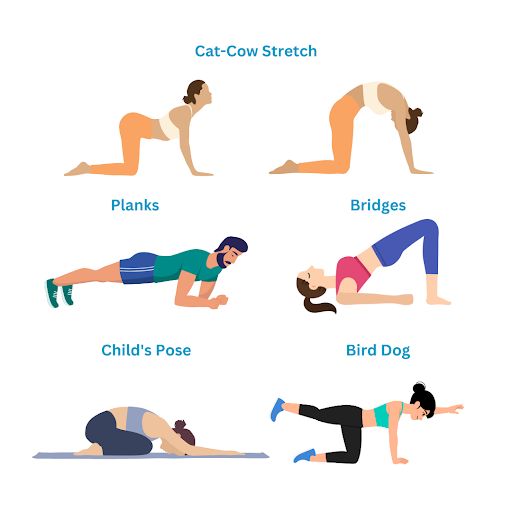
These exercises target key areas involved in postural imbalance: cervical spine, thoracic spine, hips, core, and glutes.
1. Child’s Pose
Gently decompresses the spine and relaxes tight paraspinal muscles.
Benefits:
- Reduces lower back tension
- Promotes spinal lengthening
- Relieves shoulder stress
Hold for 30–60 seconds with controlled breathing.
2. Cat–Cow Mobility Drill
Improves spinal mobility and posture awareness.
Benefits:
- Enhances cervical and thoracic motion
- Reduces stiffness
- Encourages healthy movement patterns
Perform slowly for 1–2 minutes.
3. Standing Spinal Extension
A practical alternative for office workers.
Benefits:
- Counteracts prolonged sitting
- Activates postural stabilizers
- Reduces lumbar stiffness
Repeat several times throughout the workday.
4. Downward-Facing Dog
Combines strengthening and flexibility.
Benefits:
- Strengthens the upper back
- Improves shoulder stability
- Lengthens hamstrings
- Supports spinal decompression
Hold for 30–45 seconds.
5. Forward Fold
Reduces spinal compression.
Benefits:
- Improves posterior chain flexibility
- Decreases lower back tension
- Promotes decompression
Move slowly and avoid bouncing.
6. Hip Flexor Stretch
Tight hip flexors commonly cause an anterior pelvic tilt.
Benefits:
- Reduces pelvic imbalance
- Supports lumbar alignment
- Improves upright posture
Hold 30 seconds per side.
7. Glute Activation (Glute Squeezes or Bridges)
Strong glutes stabilize the pelvis and spine.
Benefits:
- Reduces lower back strain
- Improves standing posture
- Enhances core stability
Perform 2–3 sets daily.
Daily Habits That Strengthen Posture
Exercises alone will not correct posture if daily habits reinforce poor alignment.
Posture-Supportive Strategies
- Keep screens at eye level
- Take movement breaks every 30–60 minutes
- Sit with feet flat and hips level
- Avoid crossing legs for extended periods
- Strengthen core muscles regularly
- Use ergonomic chairs and supportive pillows
- Distribute weight evenly when carrying bags
Consistency transforms alignment over time.
How Long Does Posture Correction Take?
Most patients begin noticing improvements within 4–6 weeks of consistent corrective exercise and ergonomic modification.
However, long-standing posture issues or structural spinal misalignment may require professional intervention. If joint motion is restricted, exercises alone may not fully restore alignment.
When Chiropractic Care Is Necessary for Bad Posture Correction
If posture-related pain persists despite stretching and strengthening, underlying spinal misalignment may be present.
A chiropractor evaluates:
- Spinal curvature patterns
- Segmental joint mobility
- Postural compensation
- Muscle imbalance
- Nervous system function
Chiropractic adjustments restore proper joint motion, allowing muscles to function efficiently again. Without correcting mechanical dysfunction, posture improvements may remain temporary.
Bad Posture Correction Chiropractic Care in Sherwood, Oregon
At ProCare Chiropractic – Sherwood, posture correction is addressed comprehensively and medically.
Our structured approach includes:
- Detailed spinal and postural evaluation
- Digital posture analysis
- Gentle chiropractic adjustments
- Soft tissue therapy
- Corrective exercise instruction
- Ergonomic education
- Long-term spinal maintenance strategies
By restoring spinal alignment and retraining supportive muscles, patients achieve sustainable posture correction.
Benefits of Improving Posture
As alignment improves, patients often experience:
- Reduced neck and back pain
- Fewer tension headaches
- Improved breathing mechanics
- Increased energy
- Better balance
- Lower injury risk
- Enhanced physical confidence
Posture directly influences total body function.
Can Posture Be Permanently Improved?
Posture requires ongoing maintenance, similar to physical fitness.
The objective is:
- Alignment
- Strength
- Awareness
- Consistency
When spinal joints move properly and stabilizing muscles are strong, healthy posture becomes natural rather than forced.
Routine chiropractic evaluations in Sherwood help maintain results and prevent regression.
Schedule your bad posture correction and Spinal Alignment Evaluation Today
If poor posture is contributing to neck pain, back pain, headaches, fatigue, or reduced mobility, professional evaluation can significantly accelerate improvement.
ProCare Chiropractic – Sherwood
Address: 16771 SW 12th St Ste E, Sherwood, OR 97140Book: Online BookingPhone: (971) 396-3013
Call today to schedule your comprehensive Bad posture correction and spinal alignment evaluation and begin restoring healthy alignment in 2026.