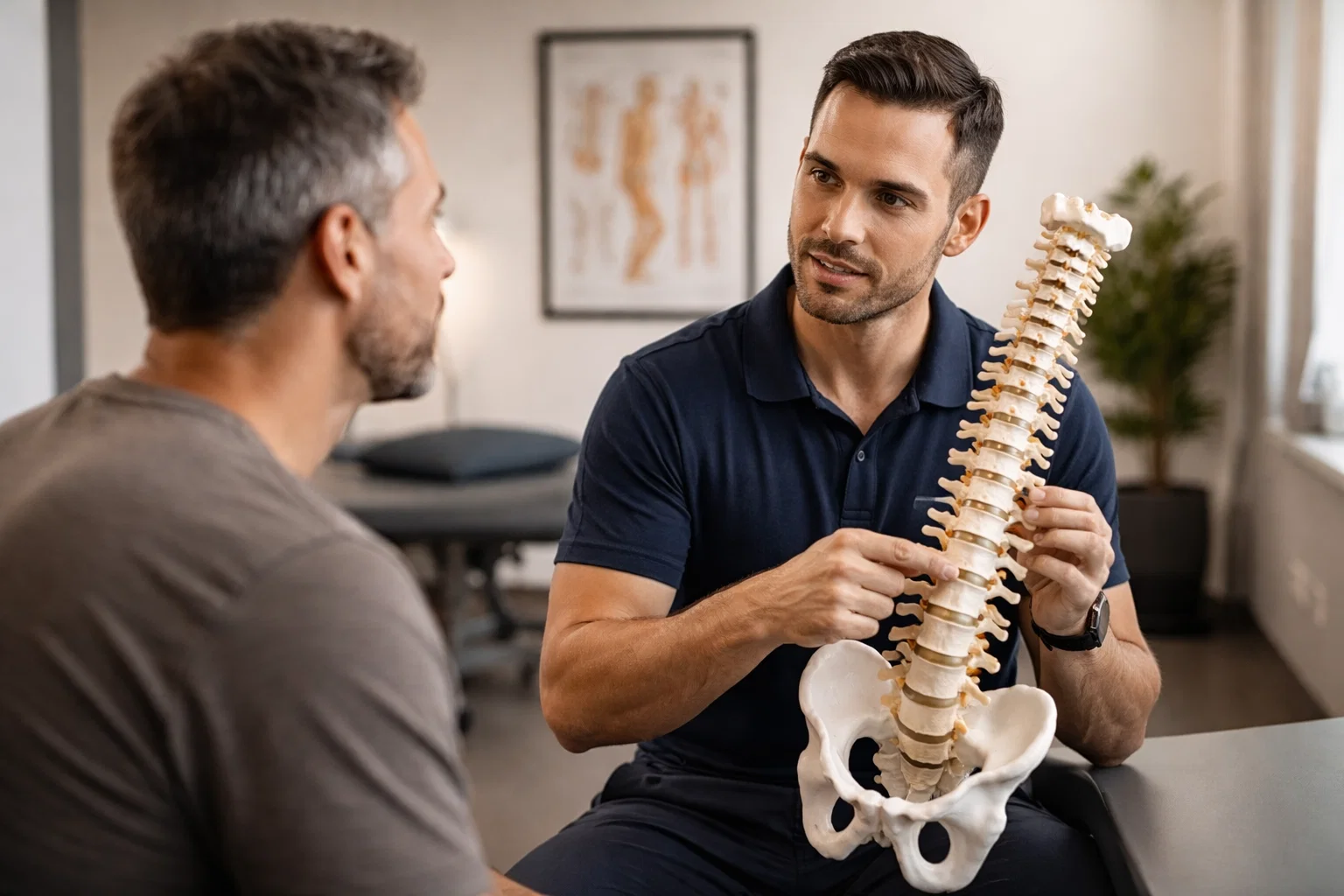
Should You Pop Your Own Back? What Really Happens to Your Joints
You know that feeling.
You’ve been sitting for hours. Your back feels tight. Your shoulders are stiff. You twist to one side, stretch a little harder, and then—
POP.
Instant relief.
For a few seconds, everything feels looser.
So naturally, you start wondering:
Is popping your own back actually safe?
Are you putting your joints back into place?
Can cracking your back cause arthritis, damage your spine, or create long-term problems?
And perhaps the biggest question of all:
What is actually happening inside your joints when you hear that sound?
The truth is more complicated than most people think.
An occasional pop during a normal stretch is very different from aggressively twisting your spine several times a day trying to force a crack.
Let’s break down what really happens to your joints, why popping can feel so good, when it may become a problem, and what you should do instead.
What Actually Makes Your Back Pop?
Despite what it may sound like, your bones are not cracking against each other.
Most of the time, the sound comes from changes in pressure inside a joint.
Your spine contains many small joints, including the facet joints between the vertebrae. These joints contain synovial fluid, which helps reduce friction and allows smooth movement.
When you stretch or move a joint, the space inside the joint can change rapidly.
This pressure change can cause dissolved gases to form a bubble inside the joint fluid.
That process is often referred to as cavitation.
The result?
POP.
The sound can be loud, but the sound itself does not necessarily mean something has been “put back into place.”
In most cases, you’re hearing a physical change inside the joint—not a bone being relocated.
The Important Part
A popping sound by itself is not automatically good or bad.
The bigger question is:
How are you creating that pop, and what symptoms are you experiencing before and after it?
Why Does Cracking Your Back Feel So Good?
If popping your back doesn’t magically “realign” your spine, why does it feel so satisfying?
Several things may be happening at once.
| What Happens | Why You May Feel Better |
|---|---|
| Joint movement | Moving a stiff joint can temporarily reduce the feeling of restriction |
| Muscle relaxation | Stretching surrounding tissues may reduce tension |
| Sensory input | Your nervous system receives new movement signals |
| Temporary pain modulation | Movement can briefly change how strongly your brain perceives discomfort |
| Psychological reinforcement | Your brain begins associating the pop with relief |
That immediate relief is real.
But here’s the catch:
Relief doesn’t always mean the underlying problem has been solved.
If you spend eight hours sitting in the same position every day, cracking your back may temporarily reduce stiffness—but the stiffness may return because the original cause hasn’t changed.
This can create a cycle:
Stiffness → Crack → Temporary relief → Stiffness returns → Crack again
And over time, the habit itself can become part of the problem.
Is It Safe to Pop Your Own Back?
For many healthy people, an occasional, gentle pop during normal movement or stretching is unlikely to be harmful.
For example:
- You stretch after waking up
- Your upper back naturally pops
- You move during yoga and hear a crack
- You twist gently and experience a painless pop
That’s very different from:
- Forcing your spine to rotate
- Pushing through pain
- Having someone aggressively step on your back
- Repeatedly cracking the same area all day
- Trying to create the loudest possible pop
The difference is important.
Your joints are designed to move.
They are not designed to be repeatedly forced beyond comfortable movement just to produce a sound.
What Can Go Wrong When You Force Your Back to Crack?
Let’s be clear:
A back pop is not automatically dangerous.
But aggressive or repeated self-manipulation can create problems.
Here are some of the biggest risks.
1. You May Be Moving the Wrong Joint
This is one of the most overlooked problems.
Imagine one part of your spine feels stiff.
You twist.
But instead of the restricted area moving, your body may compensate by moving the joints that are already highly mobile.
So you keep getting a satisfying crack—
but not necessarily from the joint you were trying to target.
Over time, repeatedly forcing movement through already-mobile joints may contribute to irritation or feelings of instability.
Meanwhile, the original stiff area may remain unchanged.
2. You Can Strain Muscles and Ligaments
Your spine is supported by muscles, ligaments, tendons, and other connective tissues.
When you aggressively twist, pull, or push yourself into a crack, those tissues experience force too.
Possible results include:
- Muscle soreness
- Ligament irritation
- Joint discomfort
- Rib irritation
- Increased stiffness afterward
If you’ve ever cracked your back and felt worse the next day, excessive force may be part of the reason.
A satisfying sound does not guarantee a beneficial movement.
3. You May Irritate a Sensitive Nerve
Forceful movements can sometimes irritate tissues around the spine.
Warning symptoms include:
- Sharp pain
- Tingling
- Numbness
- Burning sensations
- Pain traveling into an arm or leg
- Weakness
If cracking your back produces any of these symptoms, stop trying to self-adjust the area.
A pop followed by neurological symptoms is not something to repeatedly experiment with.
4. You Could Be Masking the Real Problem
This is where self-cracking can become misleading.
Maybe your back feels tight because of:
- Prolonged sitting
- Poor movement habits
- Muscle weakness
- Repetitive work
- An old injury
- Joint irritation
Or, in some cases, another medical issue that requires assessment.
If cracking provides five minutes of relief and you repeat it ten times a day, the pop may become a substitute for addressing the actual cause.
Think of it this way:
Cracking may change how you feel temporarily. It doesn’t automatically explain why you felt stiff in the first place.
The 5 Most Common Ways People Pop Their Own Back
Some methods are gentler than others.
Here are the most common approaches.
1. The Chair Twist
You sit down, grab the armrest or back of the chair, and rotate as far as possible.
Potential problem: It’s easy to use momentum and force instead of controlled movement.
If you have to pull yourself aggressively into the position, that’s a sign to back off.
2. The Floor Twist
You lie on your back, bend your knees, and rotate your lower body to one side.
When done gently, this can simply be a mobility stretch.
The problem begins when you:
- Throw your legs down quickly
- Use momentum
- Push through pain
- Repeat the movement until you hear a crack
Movement is not the problem. Forcing the movement is.
3. The Foam Roller Crack
You place a foam roller under your upper back and extend backward.
A gentle version may simply help you move through thoracic extension.
But repeatedly forcing your spine over the roller just to create multiple cracks can irritate sensitive joints.
Rule: Use the roller for controlled mobility—not as a cracking machine.
4. The Self-Hug Squeeze
You wrap your arms around yourself and squeeze your chest and upper back.
Sometimes the upper back or ribs pop.
This can happen naturally during movement.
But excessive compression or aggressive squeezing can create unnecessary strain.
5. Letting Someone “Walk on Your Back”
This is the one to be especially careful with.
The person applying pressure often doesn’t know:
- Which structures are sensitive
- How much force is appropriate
- Where the force is being directed
- Whether you have an underlying condition
You also have limited control once someone else’s body weight is involved.
A loud crack is not proof that the technique worked.
The Difference Between a Natural Pop and a Forced Crack
This is probably the easiest way to think about it.
| Natural Pop | Forced Crack |
|---|---|
| Happens during comfortable movement | Requires aggressive twisting or pushing |
| No pain | Pain before, during, or after |
| Occasional | Repeatedly needed throughout the day |
| Happens as a side effect of movement | The sound is the main goal |
| You remain in control | Excessive force or another person is involved |
The more effort required to produce the sound, the more cautious you should be.
Why Do Some People Feel Like They Need to Crack Their Back Every Day?
If you constantly feel the urge to pop your back, it’s worth asking why.
Common contributors may include:
1. Too Much Sitting
Your body isn’t designed to stay in one position indefinitely.
Even a “perfect posture” becomes uncomfortable if you hold it for hours.
2. Limited Movement Variety
If your spine only experiences a narrow range of movements every day, certain positions can begin to feel stiff.
3. Muscle Fatigue
Muscles that spend all day supporting your posture can become tired and tense.
4. Habit
This is a big one.
The cycle can become:
Feel stiff → Crack → Feel relief
Eventually, your brain may start interpreting normal stiffness as a signal that you need to crack again.
5. An Underlying Problem
Persistent discomfort, pain, weakness, or neurological symptoms deserve more than repeated self-adjustment.
When Should You NOT Pop Your Own Back?
Avoid forceful self-manipulation and seek professional advice if you have:
- Recent trauma or injury
- Known spinal instability
- Severe osteoporosis
- Recent spinal surgery
- Unexplained severe pain
- Progressive numbness or weakness
- Pain traveling down an arm or leg
- Loss of coordination
- Fever or unexplained illness with severe back pain
These situations require more caution than a simple “stretch and see if it cracks” approach.
What About Cracking Your Neck?
Your neck deserves extra caution.
People often treat neck cracking and back cracking as the same thing.
They are not.
The neck contains important nerves and blood vessels in a relatively small space.
Avoid aggressive, high-force neck twisting—especially rapid rotation intended to create a crack.
If you regularly feel the need to crack your neck, focus first on:
- Changing your work position
- Taking movement breaks
- Gentle range-of-motion exercises
- Strengthening and mobility work recommended by a qualified professional
Never chase a neck crack by repeatedly forcing rotation.
What Should You Do Instead?
If your back feels tight, try giving it movement without making the popping sound the goal.
Here are some gentler alternatives.
1. Cat-Cow
Start on your hands and knees.
Slowly round your back.
Then gently reverse the movement.
Repeat with control.
Goal: Move through a comfortable range—not maximum range.
2. Open Book Rotation
Lie on your side with your knees bent.
Reach your top arm across your body and slowly open your chest.
Allow your upper body to rotate naturally.
Hold briefly and return.
If a pop happens naturally, that’s not necessarily a problem.
But don’t force the rotation.
3. Thread the Needle
From a hands-and-knees position, slide one arm underneath your body.
Allow your upper back and shoulder to gently rotate.
Breathe slowly.
Switch sides.
4. Standing Movement Break
Sometimes the best solution is simply changing position.
Try:
- Reaching overhead
- Rolling your shoulders
- Walking for a few minutes
- Gently rotating your torso
- Taking several slow breaths
Your body may not need a dramatic adjustment.
It may just need movement.
A Better Daily Routine for a Stiff Back
Instead of waiting until your back feels desperate for a crack, build movement into your day.
Morning — 5 Minutes
- Gentle Cat-Cow
- Shoulder rolls
- Comfortable side bends
- A short walk
During the Day — Every 30–60 Minutes
- Stand up
- Change position
- Walk briefly
- Reach overhead
- Move your shoulders and hips
Evening
- Gentle mobility work
- Light strengthening
- Walking or other comfortable physical activity
The goal is not to find the perfect stretch.
The goal is to give your body regular movement variety.
The “Should I Crack My Back?” Self-Check
Before trying to force a pop, ask yourself these questions.
Question 1: Is It Painful?
- No, just stiff → Gentle movement may be reasonable.
- Yes, sharp or severe pain → Don’t force it.
Question 2: Do You Need to Do It Constantly?
- Occasionally → Likely less concerning.
- Multiple times every day → Look at the underlying cause.
Question 3: Are You Using Force?
- Gentle stretch → Lower risk.
- Aggressive twisting or pushing → Stop chasing the crack.
Question 4: Are You Experiencing Numbness or Weakness?
- No → Continue with normal caution.
- Yes → Seek medical evaluation rather than repeated self-manipulation.
Quick Decision Tree
Do you feel like cracking your back?
            │
            ▼
      Is there severe pain?
         ┌───────┐
        Yes      No
         │        │
         ▼        ▼
       STOP    Try gentle
               movement first
                    │
                    ▼
              Do you need to
              crack constantly?
                 ┌────┴────┐
                Yes        No
                 │          │
                 ▼          ▼
            Address the    A gentle,
            underlying     occasional pop
            cause          may be harmless
The Final Verdict: Should You Pop Your Own Back?
Sometimes—but don’t make the sound the goal.
An occasional, painless pop that happens naturally during normal stretching or movement is generally different from aggressively forcing your spine to crack.
Here’s the simple version:
| Situation | What to Do |
|---|---|
| Occasional painless pop during movement | Usually not a reason to panic |
| You need to crack repeatedly for relief | Look at the underlying cause |
| You have to force the movement | Stop chasing the crack |
| Cracking causes pain | Stop |
| Numbness, weakness, or radiating pain | Seek medical evaluation |
| Someone wants to aggressively walk on your back | Think twice |
The Bottom Line
Your joints don’t need to make noise to be healthy.
And a loud pop doesn’t mean your body has been “fixed.”
The best approach is usually much less dramatic:
Move regularly.
Avoid staying in one position for too long.
Build strength.
Use gentle mobility exercises.
Don’t push through pain.
And if your body constantly feels like it needs to crack just to function, don’t keep forcing the same temporary solution.
Find out why the discomfort keeps returning.
Because the goal shouldn’t be to make your back pop.
The goal should be to help your body move comfortably—whether it makes a sound or not.
What You Can Do Today
- Stop forcing painful or aggressive cracks.
- Take more movement breaks during the day.
- Try gentle mobility exercises before attempting to self-adjust.
- Add regular walking and strength training to your routine.
- Pay attention to numbness, weakness, or radiating pain.
- If you constantly need to crack your back for relief, consider speaking with a qualified healthcare professional.
Final Thoughts
That satisfying POP can make you feel like something important just happened.
Sometimes, it simply means a joint changed pressure during movement.
Nothing magical.
Nothing automatically dangerous.
But when cracking becomes a daily ritual, a response to pain, or something you have to force, it’s worth stepping back and asking a better question:
What is my body actually asking for?
More often than not, the answer isn’t a louder crack.
It’s better movement, more variety, stronger muscles, and less time spent stuck in the same position.
Because lasting relief isn’t about how impressive the sound is.
It’s about how well you can move when the sound is gone.